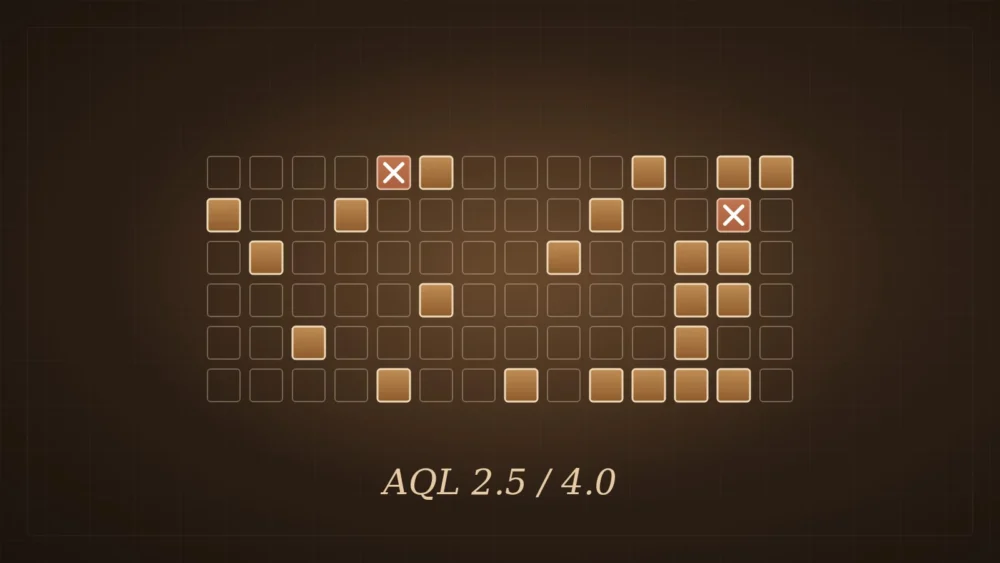
Inspection reports are full of numbers like “AQL 2.5 / 4.0”. They look technical, but the idea is simple: check a statistical sample and decide whether the whole lot can ship.
- AQL is the acceptable quality limit: the most defects tolerated in a sample for a lot to pass.
- Defects are classed as critical, major or minor, each with its own limit.
- Sample size depends on lot size, not on how many defects you hope to find.
- AQL is a sampling rule, not a promise of zero defects.
Three types of defect
| Class | Meaning | Furniture example |
|---|---|---|
| Critical | Unsafe or illegal; usually zero tolerance | Unstable chair, sharp exposed edge, banned material |
| Major | Likely to make the buyer reject the piece | Cracked joint, wrong colour, missing part |
| Minor | Small cosmetic flaw that does not affect use | Tiny finish bubble in a hidden place |
How the sample is chosen
Inspection standards such as ISO 2859-1 give a sample size based on lot size and inspection level. A common choice is general level II. Then each AQL tells you how many defects the sample may contain.
For a lot of about 1,000 units at general level II, the sample is 80 units. At AQL 2.5 for major defects, up to 5 major defects are accepted. At AQL 4.0 for minor defects, up to 7 are accepted. Critical defects are normally not accepted at all.
How to use AQL in practice
- Write the standard in the contract.State the AQL levels, the inspection level and who pays for the inspection.
- Define defects with photos.An agreed defect list with pictures removes arguments about what is “major”.
- Inspect when most of the order is packed.That way sampling covers finished, packed goods; a common point is when about 80% is ready.
- Agree what happens on failure.Rework and re-inspection at the factory’s cost is a typical clause.
Tell us your standard and we will agree what is checked, when and by whom.
Inspect the packing too: carton markings, drop protection and container loading. Many arrival problems start there, not in the workshop. See how packing affects furniture.
Where AQL fits in a supplier review
An inspection routine is one of nine things worth checking when you choose a furniture manufacturer. For how we organise checks on materials, joinery, finishing and packing, see Quality Control.