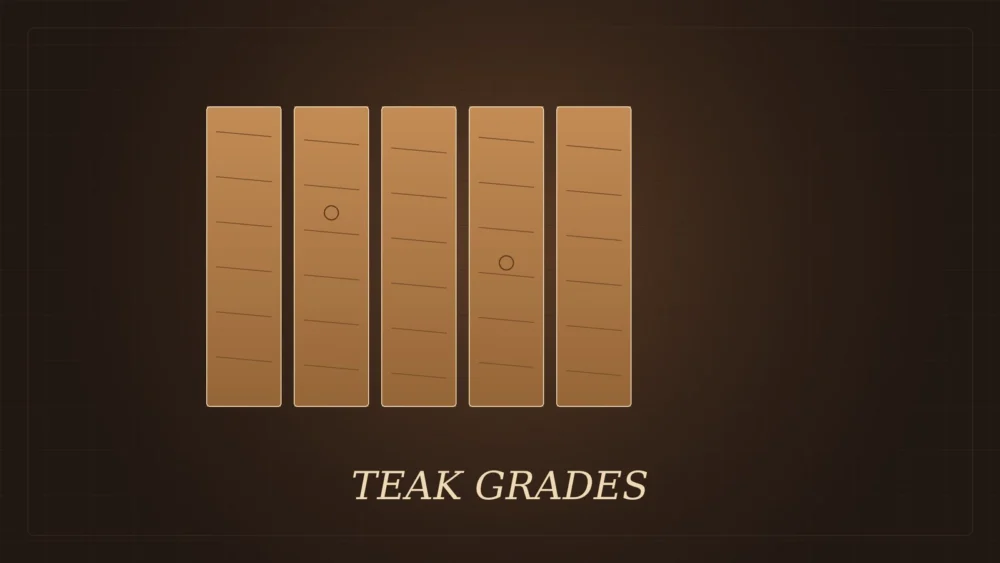
Teak is sold by grade, but there is no single global standard. The same letter can mean different things at different mills, so a grade only helps if you define it in writing.
- Teak grades describe appearance and heartwood content, not strength.
- Grade A normally means clean, uniform heartwood; lower grades allow more knots, colour variation and sapwood.
- Every supplier uses its own definitions, so attach photos and tolerances to the spec.
- Matching grade to the visible surface saves money without hurting the finished piece.
What a teak grade actually describes
Teak grading is a visual and commercial system. A grader looks at heartwood colour, how even it is from board to board, the size and number of knots, and whether pale sapwood is present. Because mills set their own rules, “Grade A” from one supplier may look different from another.
| Grade | Typical look | Best used for |
|---|---|---|
| A | Even golden-brown heartwood, very few knots, little or no sapwood | Tabletops, door fronts, visible surfaces |
| B | Some colour variation, small sound knots, minor sapwood allowed | Chair frames, side panels, general furniture |
| C | Strong variation, larger knots, more sapwood | Hidden parts, rustic designs, painted or textured finishes |
Why colour and grain vary
Teak colour depends on the tree, the growing conditions and how the log is cut. Boards from different trees can sit next to each other with a visible colour step. Good factories sort and match boards before gluing up a panel, and finishing can reduce but not remove the difference.
How to write a grade into your order
- Name the grade and attach reference photos of the lowest acceptable board.
- State the knot limit: size, number per board and whether sound knots only.
- State whether sapwood is allowed and on which surfaces.
- Say whether boards must be colour-matched within a panel.
- Keep an approved sample as the physical reference.
Send us your target look and budget and we will propose a grade mix with photo references.
Specify the grade by surface, not by product. “Grade A on top and front faces, Grade B elsewhere” is often cheaper than Grade A throughout, and a buyer opening the carton will not see the difference.
Grade, moisture and legality
A beautiful board that is poorly dried will still crack. Ask for the drying method and moisture target in the same spec; see our guide to kiln-dried wood and moisture content. For export, also ask for timber legality documents, explained in the SVLK and FSC buyer guide.
If you would like to see finished examples, browse our furniture catalog.
Our quality control process shows how these material checks are applied at the factory.